Total volume of solution delivered by the burette buret to reach the end point of the titration. Add titrant from the buret to the flask while stirring magnetically or swirling the flask with your hand.

Titration Chemwiki Teaching Chemistry Chemistry Lessons Science Chemistry
Regardless of which titration reaction is used the following criteria must be met for a titration to be successful.
. See the answer Show transcribed image text Expert Answer 100 3 ratings. Filling the burette 9. Solution being titrated in order to detemine its concentration.
Make sure you have a calibrated burette a burette stand multiple beakers andor Erlenmeyer flasks a measured amount of your analyte and a large quantity of your titrant before you begin. It is a common technique used for measuring amounts of acids and bases and is then called an acid-base titration. Write down known information 2.
Correct procedures for a titration include which of the following. Solution splashed on the walls of the flask may be washed down with water. Repeat Write down known information -concentration of sodium hydroxide.
While a magnetic stir plate isnt required it can be very useful. Correct procedures for a titration include which of the following. Rinsing the buret with distilled water just before filling it with the liquid to be titrated III.
Course Title CHEM 160115. Rinsing the buret with distilled water just before filling it with the liquid to be titrated III. The process of adding one solution to another until the reaction is just completed.
Create a data table 3. Afterwards choose the titrate. Adding the indicator 8.
Correct procedures for a titration include which of the following. Draining a pipet by touching the tip to the side of the container used for the titration II. Pages 16 This preview shows page 3 - 5 out of 16 pages.
Fill the burtte with known concentration of an acid or base. Furthermore choose the volume of the liquid to be pipetted out. Tour Start here for a quick overview of the site Help Center Detailed answers to any questions you might have Meta Discuss the workings and policies of this site.
The analyte must be placed in a large beaker The tip of the buret must be filled with the titrant. Solution of known concentration. Record the initial buret reading in your notebook.
Titrating the unknown solution 10. Label the beakers 5. Take a burtte reading from the top of the miniscus.
Add a few drops of the appropriate indicator to the flask. Draining a pipet by touching the tip to the side of the container used for the titration II. Rinsing the buret with distilled water just before filling it with the liquid to be titrated III.
Place a flask with a unknown concentration of acid or base under the burtte. Steps for a titration 1. Correct procedures for a titration include which of the following.
Draining a pipet by touching the tip to the side of the container used for the titration II. Swirling the solution frequently during the titration A. Only a few drops of indicator solution should be used This problem has been solved.
A titration is a process in which a measured volume of a solution is added to a reaction mixture until some observable property has changed. The procedure For the Types of Titration Firstly choose the titrant. Drain the pipet by touching the tip to the side 2.
Correct procedures for a titration include which of the following a Draining a. That is the type of titration described here. This titrant is then made to react with the analyte until some endpoint or equivalence point is reached at which stage the concentration of the analyte can be determined by measuring the amount of titrant consumed.
IDraining a pipet by touching the tip to the side of the container used for the titration IIRinsing the buret with distilled water just before filling it with the liquid to be titrated IIISwirling the solution frequently during the titration. Performing a titration requires that you have all your equipment together before you start. Swirl the solution frequently during the titration I and ll I only 1 I and IIl Il and Il 17.
Using the pipette 7. Close the stopcock when the endpoint is seen. Because titration is an analytical technique.
Correct procedures for a titration include which of the following. 1 There must be a direct stoichiometric relationship between the reactive species such that no alternative or side-reactions. Correct procedures for a titration include which of the following.
Titration Procedure The process of titration involves the preparation of a titranttitrator which is a standard solution whose volume and concentration are predetermined. View Screenshot 40png from SCIENCE 101 at Woods Charter School. Rinsing the buret with distilled water just before filling it with the liquid to be titrated.
Select the normality of the titrate. I and III only. Calculate the amount of titrant needed to reach the endpoint.
Record the final buret reading in your notebook. Draining a pipet by touching the tip to the side of the container used for the titration. Moreover select the indicator.
Correct procedures for a titration include which of. Rinse the buret with distilled water just before titration 3.
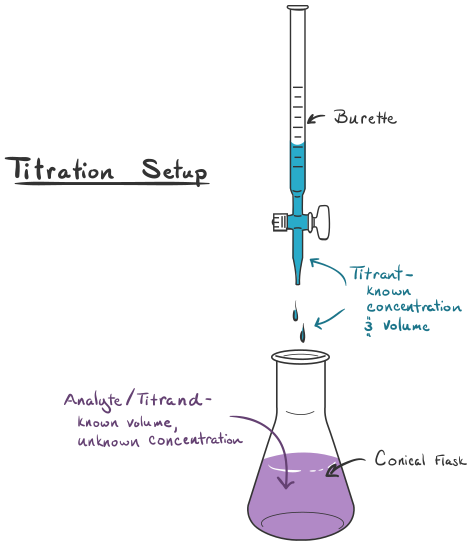
Titration Curves Equivalence Point Article Khan Academy

Titration Of Aspirin Lab Macro Lab Student Data Cooperative Learning Chemistry Class

Pin On Epharmacology

How Is Titration Used In The Pharmaceutical Industry



0 Comments